

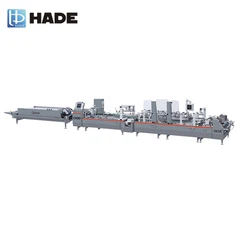

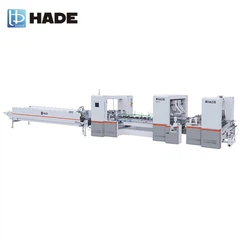
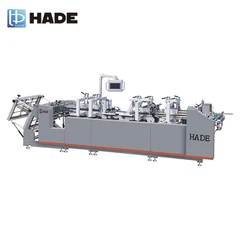
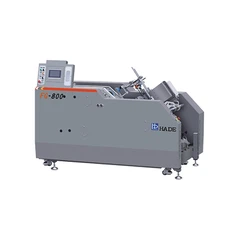
In the production process of corrugated boxes, automatic adhesive carton machine as an important equipment, directly affects production efficiency, product quality and cost control. Faced with a variety of equipment on the market, enterprises need to make comprehensive evaluation from various dimensions such as production scale, product type, technical parameters, environmental requirements and after-sales service, and choose the most suitable solution for their needs.
I. Clarifying Production Scale and Capacity Requirements
1.Small-scale Carton Factories: prioritising Flexibility and efficiency
For a small-scale carton factories with a daily production capacity of less than 10,000 square meters, it is best to choose a small fully automatic adhesive box machine. They cover a relatively small area (typically between three and five metres overall) and are relatively affordable (between $11,000 and $50).
21,000).And the operation is simple, operators need just 3 to 5 days of training to master the operation process. For example, a certain type of belt front edge suction paper feed system, paper feed speed can be 0-130 m/ min. With frequency conversion speed control system, can be flexibly adapted to different specifications of corrugated boxes production. Its core advantages include:
Labor saving: The entire production process requires only 2-3 operators.
High forming accuracy: the gluing error is controlled to ±1mm by cardboard correction device and crease correction device.
Low maintenance costs: standardized design of major components to facilitate replacement of parts.
2.Large-scale Carton Factories: High-speed Linkage Lines is key
For large enterprises with a daily capacity of more than 50000 square meters, high-speed connectivity is the core equipment to enhance competitiveness. These devices are usually integrated with functional modules such as vacuum paper, glue coating and folding, counting and stacking, and can operate at speeds of more than 150 metres per minute. Take, for example, one type of high-speed adhesive:
Production efficiency: 9,000-12,000 cartons per hour, three to 5 times the efficiency of semi-automated equipment.
High degree of automation: support with water ink slotting die-cutting machine, binding machine, stacking machine and other equipment, to achieve complete dehumanization of the entire production process.
Stability: PLC control system and touch screen parameter setting, failure rate less than 0.5%, can operate continuously for more than 8 hours, no malfunction.
ii. Product Types and Process Requirements
1. Standard Fold-up Boxes: Balance Semi-automatic and Fully Automatic Options
For standard foldable binders made of a single outer packaging material, the following technical details require particular attention:
Folding wire processing: Equipment must be compatible with cardboard that has been pressed into the foldable wire, otherwise a defective product may be produced. A semi-automatic adhesive machine of a certain type can handle cardboard from 400mm x 400mm to 1200mm x 200mm through adjustable crease correction device.
Stainless steel wheel glue coating technology is adopted to control the glue amount error within ±0.1g/m2 to prevent the plastic from spilling over and deforming the cardboard.
Drying efficiency: With a hot air circulation system, the glue can solidify initially in 3-5 seconds, reducing the risk of adhesion during stacking.
2. Alien Boxes and colour boxes: the Advantagess of Multi-functional Equipment
For products that require two pieces of adhesive to be formed into a box, cartridge or special shaped structure, it is recommended to select devices that have the following functions:
Local spray: through the nozzle to achieve a special shape of the box precision coating, glue coverage rate of up to 98%.
Abrasive pre-treatment: Coarse processing of the adhesive to enhance the adhesion of the adhesive, so as to increase the peel strength by 30%.
Multi-material compatibility: supports mixed production of A/B/C flute corrugated cardboard with thickness between 2 and 8mm.
III. In-depth analysis of Technical Parameters
1. Core Performance Indicators
Adhesive accuracy: Error should be controlled to ±1mm or less, otherwise the packaging appearance and stacking stability will be affected.
Speed of operation: It is recommended to select equipment operating continuously at a rate of not less than 80 metres per minute to meet the requirements of mass production.
Stability: The equipment shall pass a 24-hour continuous operation test with an average failure interval of more than 2,000 hours.
2. Electricity and Energy Consumption
Power supply Configuration: Mainstream uses a 380V three-phase power supply with a power range of 5-15kW.
Energy-saving design: Preference is given to equipment equipped with frequency conversion speed control system, which can reduce energy consumption by 20% to 30%.
Air pressure requirements: Some devices require compressed air systems with a pressure of between 0.6 and 0.8MPa to drive pneumatic components.
3. Intelligent Functions
Data monitoring: real-time acquisition of production data (e.g. speed, temperature, glue amount, etc.) through sensors and touch screens.
Fault warning: When equipment malfunctions, the system automatically alerts and records a code for the malfunction to quick troubleshooting.
Remote maintenance: supports remote diagnostics and software upgrades the Internet to reduce downtime.
IV. INTRODUCTION Environmental and Sustainability Considerations
1. Glue Selection
Hydrocolloids: Suitable for areas with high hygiene requirements such as food and drug packaging and VOC emissions below 50mg/m3.
Hot melt glue: characterized by fast curing speed (1-3 seconds), no need for drying equipment, energy saving over 30%.
PUR glue: High strength, weatherproof, suitable for high-end gift boxes and product packaging, but at a higher price.
2. Waste Treatment
Die-cutting waste paper removal: part of the equipment set die cutting pressure adjustment and waste paper removal device in one, using sponge auxiliary function to prevent paper scrap accumulation.
Dust removal: improvement workshop environment environment with negative pressure dust collection system to control dust concentration below 10mg/m3.
V. Evaluating the value of after-sales service
1. Installation and commissioning
Professional team: Supplier shall provide free on-site installation service and complete equipment commissioning within 2-3 days.
Training support: including operation training, daily maintenance training, fault management training, etc., to ensure that customers can operate independently.
2. Repair response
Response time: Promises to be on site within 24 hours for maintenance and no more than 48 hours in remote areas.
Spare parts supply: Establish stock of commonly used spare parts to ensure that over 80% of vulnerable spare parts can be replaced on site.
3. Long-term cooperation
Warranty period: It is recommended to choose equipment with a 1-2 year free warranty and to ensure the price of spare parts is transparent after the warranty period.
Technology Upgrade: Preference is given to suppliers with independent R & D development capabilities to facilitate future functional expansion or technological upgrading.
VI. INTRODUCTION Practical Case References
Case 1: Upgrading of equipment a Medium-sized Carton Factory
The enterprise initially used semi-automatic adhesive machines with a daily production capacity of about 30,000 square metres. After introducing a certain type of automatic high speed adhesive machine:
Productivity boost: Up to 80,000 square metres per day, 167% efficiency.
Manpower saving: reduced from 8 to 3 operators.
Quality improvement: Deficiencies decreased from 3 per cent to 0.5 per cent, and customer complaints decreased by 70%.
Case 2: Multi-functional Requirements for colour box factories
The enterprise needed to produce a variety of special shaped color boxes, the original color box equipment could no longer meet the requirements. After replacement with equipment with local spray and abrasion:
Product adaptability: can handle more than 10 different structures such as circular box and trapezoidal boxes.
Improve material utilization: through precision glue coating, the amount of glue consumption is reduced by 25%.
Shorter lead times: The lead time was shortened from 7 to 3 days, resulting in a significant increase in customer satisfaction.
VII. Summary and recommendations
When choosing an automatic adhesive machine, enterprises should follow the principle of "tailoring":
Small businesses: Prioritize cost-effective and easy-to-operate equipment and build up finance and technology.
Medium-sized enterprises: Focus on the versatility and scalability of equipment, leaving room for future upgrades.
Large enterprises: invest in high-speed linked production line, build intelligent production system, improve comprehensive competitiveness.
In addition, it is recommended that companies conduct site visits to the supplier's production base and customer cases before making decisions, and attend industry exhibitions to keep abreast of the latest technology trends. Through the comprehensive evaluation of equipment performance, after-sales service, long-term costs and so on, enterprises can choose the most suitable for their corrugated box production needs of automatic adhesive box machine, for the production process to inject lasting impetus.
How To Choose The Right Automatic Gluing Machine For Your Corrugated Box Needs?
May 15, 2026
Leave a message