

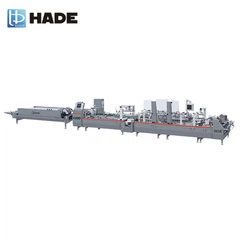

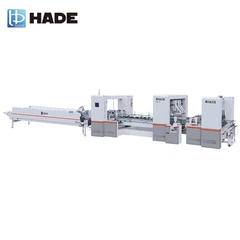
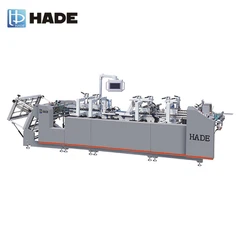
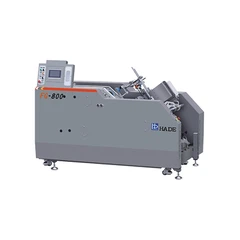
In the wave of intelligent transformation sweeping the packaging industry, corrugated carton self-adhesive machine as a key equipment to connect production and logistics. Their technological development directly determines the efficiency and quality of packaging. From traditional manual adhesives to modern intelligent control systems, these machines have formed a comprehensive technical framework encompassing several dimensions, including mechanical structure, adhesive application and intelligent control. According to the latest development trend of corrugated box machine industry, this paper systematically analyzes the core features of corrugated boxes box machine.
Efficient and Precise Gluing Systems
1.1 Dynamic Flow Control Technology
Modern adhesive machine adopts servo motor driven gearpump system to monitor the running speed of cardboard in real time and realize dynamic matching of adhesive flow. For example, a certain brand's equipment can process cardboard with a width of 1200 mm at a bonding speed of 15 m/min, while maintaining an adhesion quantity error g/m2. The closed-loop control system ensures uniform bonding during acceleration/deceleration phases by encoder feedback signals.
1.2 Multi-mode Gluing Mechanisms
In order to meet the requirements of diverse box types, equipment is equipped with switchable gluing modules:
Roller Coating: suitable for planar bonding, the thickness of the adhesive layer can be controlled by adjusting the roller gap (0.1–5 mm). When used in conjunction with a silicone rollers, the mirror-finish gluing effects can be achieved.
Spray Gluing Systems: high-pressure atomization technology can achieve a minimum spray width of 1mm, is an ideal equipment for local reinforcement of irregular box adhesion. Some models are equipped with smart spray guns with solenoid valve arrays that can turn on andoff quickly for 0.1 seconds to prevent adhesive trailing.
Blade systems: Specially developed for coated cardboard, these special scrapers are made of tungsten carbide materials and last more than half a million cycles. glue layer thickness can be precisely controlled in the range of 0.05-0.3 mm.
Intelligent process control
2.1 Vision Positioning Systems
Integrated industrial camera positioning module can recognize the QR code, color marks or edge features on cardboard in real time and automatically correct feeding deviations. Artificial intelligence vision algorithm developed by one enterprise maintain positioning accuracy of ± 0.2 mm --five times that of traditional photoelectric sensors --even when dealing with recycled cardboard with a 3 percent distortion rate.
2.2 Adaptive Pressure Regulation
The pressure vessel employs pneumatic-hydraulic intensifier cylinder technology with pressure ranges 0.1 – 5 MPa. Through feedback from pressure sensor feedback, the system automatically adjusts pressure parameters to the basis weights of the cardboard (150–500 g/m2). For example, when dealing with E-flute corrugated board, the system uses a segmented pressing process: an initial pressure 0.3 MPa lasts for 2 seconds, then gradually increased to 1.2 MPa for 0.5 seconds to ensure complete adhesion without crushing the cardboard.
2.3 Smart Maintenance Prediction
IoT-based predictive maintenance systems provide real-time monitoring of critical component conditions:
Automatic alarm when the temperature of glue pump bearing exceeds 65 degrees celsius.
Initiate cleaning procedures in case of abnormal pressure fluctuation of hose
When wear reaches 0.5 mm, replace the drum in time.
One model uses big data analysis to improve Overall Effectiveness of devices to 92%, 18 percentage point more than traditional devices.
Material Adaptability Optimization
3.1 Adhesive Compatibility Design
Equipment supports a variety of adhesive types for different applications:
Water-based Adhesives: with heating/insulation systems (adjustable 40-60°C) to prevent solidification
Hot Melt Adhesives: PID temperature control, furnace temperature fluctuations is controlled within ±1°C
PUR Adhesives: Extended adhesive life to 8 hours with a nitrogen-protected nitrogen protection glue path design
3.2 Cardboard Treatment Technologies
To solve the problem of binding to coated cardboard, a model developed a triple processing process:
Corona treatment: Increasing the concentration of surface dyes to more than 42 dyes by high voltage discharge
Mechanical Abrasion: Diamond sand rollers removes surface coatings to expose fiber structures
Plasma cleaning: Generates high-energy ion beams to clean surfaces and enhance adhesion
Tests show that the process increases peel strength of coated cardboard from 0.8 N/15 mm to 3.2 N/15 mm.
Modular Structural Design
4.1 Rapid Changeover Systems
Quick changes to the bonding module design can:
Replacement of rubber head within ≤3 minutes
Pressure plate adjustment within ≤5 minutes
Automatic toggle parameters scanned by barcode
One enterprise's "intelligent tooling" system uses RFID label to store equipment configuration parameters, achieving "one-pint, one-yard" precision management.
4.2 Expandable Function Integration
Mainstream models retain multiple function interfaces:
Quality Inspection Modules: Integrated Infrared Sensors for glue distribution Testing
Defect Rejection Devices: Automatic separation of non-conforming products using pneumatic pushers
Data Acquisition Terminals: linked to MES systems for production traceability
The laminators on A 12-color printing line's package integrate a CCD inspection systems, reducing defect rates from 2 percent to 0.3 percent.
Environmental and Safety Design
5.1 Energy-Saving Technologies
Variable frequency drive systems: according to the production rhythm automatically adjust motor power, to achieve 30% energy-saving effect.
Heat recovery unit: Recycle melting furnace waste heat for adhesive preheating, energy consumption reduced by 15%
Standby modes: automatically enters low power consumption at non-production stages, power consumption ≤50 W
5.2 Safety Protections
Dual protection doors: Combining mechanical interlock with photoelectric sensors to prevent misoperation
Glue mist collection systems: negative pressure suction reduces workshop VOC concentrations
Emergency brake: Trilateral emergency brake button with response time ≤ 0.2 seconds
One model passed CE certification tests while maintaining operators safe at a cardboard speed of 2 m/s.
Industry Applications
6.1 E-commerce packaging solutions
One logistics enterprise's intelligent gluing line has been implemented:
Daily processing capacity: 120,000 person-days
type compatibility: Cover F Flute Microwave to 7-Layer AB Flute
Energy saving: Adhesives are 25% less than conventional equipment.
6.2 Cold Chain Packaging Innovations
For insulation boxes used in -18°C environments, one enterprise has developed:
Special adhesive for low temperature, maintaining 85% bonding strength at -40°C
Rapid curing process achieves initial strength within 3 seconds of bonding
Design of a double layer adhesive structure to prevent water vapor penetration
6.3 Digital Factory Practices
Adhesives integrated in one packaging group's smart factory:
AGV automatic feeder trolley
Visual inspection systems for Real-Time Adhesive Quality Monitoring
Remote equipment diagnostics Cloud platforms
A complete intelligent manufacturing ecosystem has been formed, and the comprehensive utilization rate of equipment has been raised to 95%.
Technology Development Trends
7.1 AI Integration
Next generation devices will incorporate:
Deep learning algorithms for Automatic Adhesive path optimization
Digital twin virtual debugging technology reduces downtime
Augmented reality (AR) for remote device maintenance guidance
7.2 Green Manufacturing Upgrades
Areas of research include:
Biobased Adhesives Applications
Zero-VOC emission technologies
Adhesive recovery and reuse systems
7.3 Ultra-Flexible Production
By:
Modular designs capable of ``LEGO "equipment combination
Adaptive controls of automatic recognition of cardboard deformation
Cloud-based parameter libraries for quick access to best processes
These advancements will meet the customization demands of small-scale, multi-variety production.
Conclusion:
The development of corrugated self-adhesive box reflects the profound transformations in packaging industry from ``manufacturing"to ``intelligent manufacturing ''. Through sustained technological innovation, these machines have not only broken through traditional metrics such as efficiency and accuracy, but have also broken new ground in intelligence and sustainability. With the arrival of Industry 4.0, intelligent gluing systems with autonomouslearning ability will become core equipment of soft packaging production lines construction, injecting new kinetic energy into the high-quality development of the industry.