

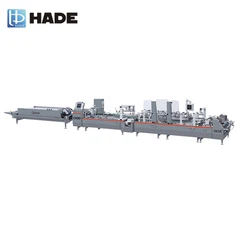

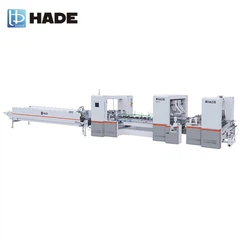
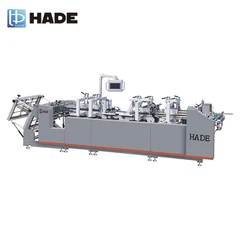
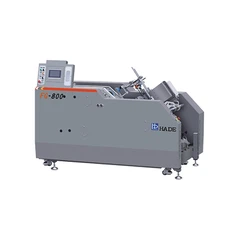
In packaging printing industry, folding and bonding are the key processes in carton production, which directly affect the quality and efficiency of finished products. Different types of carton (such as linear carton, lock carton, boxer) have different functional requirements for folding machine and adhesive machine. According to the structural characteristics, production scale and process requirements of the carton, this paper will systematically expound how to select suitable folding machine and adhesive machine scientifically, combined with a detailed analysis of more than 1000 words.
Relationship between Carton Types and folding/ bonding process
1.Process Characteristics of Straight Line Box
Straight line box represents the basic carton structure, with a single straight folding path, no complex corner folds or locking mechanism. During production, equipment must complete three key processes: prefolding, bonding and stamping. Emphasis is placed on ensuring accurate crease accuracy and uniform glue application. Because of its simple structure, linear boxes require relatively low automation of equipment but high stability of high-speed operation.
2.Process Features of Bottom Locker
Lock box self-locks through an interlocking tag and slots at the bottom, requiring no tape or stapler. Production challenges include:
Precision molded floor requires specialized tooling
Pre-folding and positioning of labels during folding
Prevent tab deformation or dislocation during high-speed operation
This carton requires to be equipped with automatic bottom locking modules and high precision mechanical positioning systems.
3.Process Characteristics of Quadrant Boxes
The quadrangle box (including the hexagonal variant) is an irregular package with a folding path containing multiple non-right angled creases. Implementation requires:
Multi-axis servo control systems with Complex motion trajectories
Specialized corner-folding units (e.g., 4/6-corner modules) designed for non-standard creases
Visual positioning systems for compensating material deformation errors
Such equipment must be modular in design and flexible in configuration of functional units.
Core Technical Parameters for Equipment Selection
1. Mechanical Structure Compatibility
Straight line box: Choose a basic binder with adjustable prefold (with a crease angle range of 120°-180°) and even gluing systems.
Bottom Locker: Priority is given to devices with automatic bottom locking modules, focusing on fabrication accuracy (±0.1mm) and folding speed (≥150 meters/minute).
Quadrilateral box: Intelligent device requiring multi-axis linkage control with:
Independent servo motors drive each folding device
Folding error compensation functions
Real-time monitoring system
2. Automated control level
Basic Type: Utilize PLC control systems, supporting manual parameter setting, suitable for small batch production.
Smart mode: equipped with a digital control system that can:
Automatic storage and retrieval of box parameters
Real-time production data collection and analysis
Remote fault diagnosis and software upgrades
For multi-breed, small-batch production models, it is recommended to use devices with memory functions to reduce changeover times.
3. Material Adaptability
Cardboard: choose the adjustable amount of adhesive equipment, suitable for all kinds of adhesive.
Corrugated board: Vibration damping feeding system and pressurized conveyor are required to ensure stable passage of thick material through folding device.
Composites: Preheating equipment is recommended to improve the permeability of adhesives through temperature control.
Equipment Configuration Solutions for Typical Application Scenarios
1. Food packaging linear box production line
A food enterprise that produces linear boxes every day uses this configuration:
Basic adhesive machine (800mm wide)
Cold glue system that support water-based and hot melt conversion
Quality inspection module for Real-Time Defects Elimination
The scheme is stable and the product qualification is improved.
2. Smart Pharmaceutical Lock-Bottom Box Production
Pharmaceutical companies implementing GMP certification requirements:
Automatic Bottom Lock Adhesive Machine, Dust Free Adhesive System
Integrated vision inspection System for micrometer-level defects
Data traceability module to record entire production process
Afterimplementation, single shift capacity increased and labor costs decreased.
3. Flexible Cosmetic Four-Corner Box Production
cosmetics company are required to operate a variety of irregular size boxes with modular equipment:
Base frame to support rapid replacement of functional components
It comes with a 4/6-corner folding devices and rotating folding module.
Intelligent changeover system shortens model conversion time
This method improves equipment utilization and the response time of orders.
INTRODUCTION Economic evaluation of Equipment Selection
1. Calculation of payback period for investments
For example: a medium-sized packaging enterprise
Traditional equipment: lower unit price, but different boxes require more than one machine, total investment is high.
Intelligent equipment: high unit price, but through modular design to achieve versatility, reduce the overall cost.
Calculations showed that smart devices have shorter payback periods and lower long-term operating costs.
2. Total lifecycle cost analysis
Equipment choices must consider hidden costs, including:
Energy consumption: Intelligent equipment with servo drive systems is more energy efficient than traditional model.
Maintenance: Modular designs reduces replacement time and maintenance costs for spare parts.
Upgrade: Digital devices support software iterations to avoid complete system obsolescence.
Industry Trends and Selection Recommendations
1. Technological Development Directions
Intelligent: AI algorithms allow adaptive parameter adjustments with minimal manual intervention.
Green manufacturing: development of water-based adhesive equipment to reduce VOC emissions.
Integration: Formation of a set of die-cutting machine, inspection equipment, folding machine / adhesive machine in the whole process of automatic intelligent production line.
2. Selection Strategy Recommendations
Mass production: Priority is given to high speed and stable equipment, focusing mainly on spindle line speed and MTBF (failure interval).
Customized production: Select modular smart devices, focusing on the scalability and compatibility of functional units.
Budget-sensitive projects: use a combination of domestically produced equipment and imported core components to balance performance and cost.
Conclusion:
Matching carton types with appropriate folding and bonding equipment is key to enhancing productivity. The enterprise must make a comprehensive evaluation from three dimensions of box structure, material characteristics and production scale, and consider the development trends of intelligent and green development, and choose the technologically advanced and economical equipment solution. Scientific selection can improved production efficiency, reduce operating costs, stabilize product quality and help enterprises gain competitive advantage in fierce market competition.