

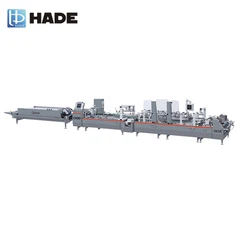

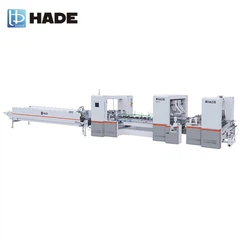
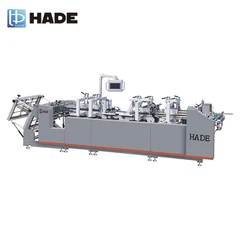
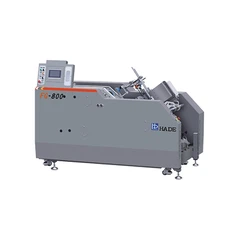
In the packaging industry, corrugated boxes as the core carriers of logistics transportation and product protection, its quality directly affects the safety, transport efficiency and brand image of commodities. With the wide application of automation technology, automatic adhesive box machine has become key equipment to improve the quality of the box by its ability of precise control, efficient production and intelligent optimization. This paper systematically analyzes how to improve the quality of corrugated carton by means of four aspects: material adaptability, process parameter control, structural stability enhancement and quality inspection systems.
1.Precise Material Adaptation: Guaranteeing Base Box Performance at Source
The quality of corrugated carton lies based on the selection and adaptation of raw materials. Automatic gluing machines adopts digital management systems, monitors physical performance index of the substrate paper (such as annular compressive strength, cracking strength, water absorption strength, etc.), and automatically adjusts process parameters according to the design requirements of the carton. For example, for cartons used in high-humidity environments, the system prioritizes high sizing degree base paper and reduces the application of glue to prevent moisture absorption and softening. For industrial packaging that requires resistance to heavy loads, it can increase the content of starch paste solids and optimize flute profiles (for example, with double-wall or high-strength corrugated paper) to significantly enhance box compressive strength.
A large packaging enterprise has been due to the substrate absorbent rate is too high and 8% depreciation rate. After the introduction of the automatic adhesive machine, the system's sensors continuously detected the paper moisture content of the substrate paper, automatically triggers the temperature adjustment of the preheat roller and steam spray compensation mechanisms. This method stabilizes the moisture content of the base paper in the optimal range of 9%-12%. Combining with low adhesive coating process, the compressive strength of the carton can be increased by 25% and the collapse rate can be reduced to below 1.5%.
2.Intelligent Process Parameter Control: Addressing Traditional Production Pain Points
Traditional gluing processes relies on manual operation, which often leads to uneven glue application, pressure control error, etc., which leads to weak bonding or broken flutes. Automatic adhesive machine implements three core processes precisely through closed-loop control system:
2.1 Glue Application System Optimization
Servo motor-driven quantitative glue application devices can automatically adjust the output of glue gun according to paperboard thickness (0.5mm-15mm), and accuracy remains within ±0.05g/m2. For example, in the production of 0201 standard boxes, the system uses laser scanning to determine flute height and accurately matches the width of the glue by 1.5mm on either side of flute's peak, preventing glue from seeping into flute valley and thus compromising structural integrity. In food packaging enterprises using this technology, the binding strength of the box increased from 1.2N/m to 2.8N/m, far exceeding national standards (≥1.5N/m).
2.2 Dynamic Pressure Regulation
The device continuously monitors and adjusts bonding pressure through pressure sensors connected to the hydraulic system. During folding, the system distributes pressure according to the size of the case: 0.3MPa low pressure (e.g., 300mm×200mm×150mm) for rapid forming small cases and 0.5 MPa -0.8 MPa grade pressure (e.g. 120 mm x 800 mm x 600mm) for large boxes to prevent flute breakage. One home appliance manufacturer reported that the technology reduced the loss of edge crush strength from 18% to below 5% on large boxes.
2.3 Closed-loop temperature management
For hot melt bonding, the equipment incorporates infrared thermometers and PID temperature control modules to maintain the temperature of the glue tank fluctuating within + -2°C. In the production of frozen food packaging, the system automatically reduces the bonding temperature from 180°C to 160°C to prevent high-temperature carbonization of paper fiber carbonization, while extending cooling channel (from 3 metres to 5 metres) to ensure complete bonding and solidification. This increased bond retention from 72% to 95% in -18 ° C environments.
3. Structural Stability Enhancement: breaking through Traditional Design Limitations
Automated Adhesives Optimize Box Structure Through Digital Modeling and simulation technologies:
3.1 Intelligent Box Type Matching
The built-in database of more than 200 international standard box types (e.g., FEFCO standards) automatically generates optimal box designs based on the size and weight of the cargoes. For long and thin cargoes with an aspect ratio of more than 3:1, it is recommended to use 0427 self-locking bottom boxes to increase the folding and bonding area the chassis and increase compressive strength by 40%. For fragile packaging, the use of a 0310 telescopic lid boxes combined with E-flute corrugation and liner is recommended to reduce drop damage from 5% to 0.3%.
3.2 Ventilation Hole Optimization
Finite element analysis simulates the effect of hole placement on structural strength of a box that requires to be opened for ventilation or observation. When a 50mm diameter vent is added to fruit packaging, the system places the vent 15mm away from Descartes' peak and uses a circular rather than square design, reducing local strength loss from 35% to 12%.
3.3 Creasing Depth Control
Laser positioning and pneumatic creasing devices automatically adjusts the crease wheel pressure (0.2MPa-0.6MPa) and depth (0.3mm-0.8mm) according to the thickness of the cardboard. Three-tiered corrugated box (250g/m2 liner + 140g/m2 medium) with a crease depth of 0.5mm ensures less than 10 10% breakage rates when creased, preventing flute breakage. Printing enterprises using the technology reduced the failure rate of cartons from 8% to 1.2%.
4. Quality Inspection System: Realizing the Traceability and Improvement of the Whole Process
Automatic adhesive machine integrates the multidimensional quality inspection module to realize closed-loop control from raw material to finished products:
4.1 Online Inspection System
High-precision cameras and machine vision algorithms continuously monitor box appearance (such as stains, color variations, burrs) with an accuracy of 0.05mm, while tensile testers checks bond strength of 3 boxes per minute and the data is automatically uploaded to MES systems. For logistics enterprise using the system, customer complaint rates fell from 2.3% to 0.5%.
4.2 Batch Traceability Management
Each box receives a unique QR code to record batches of raw materials, production parameters, and inspection data. When quality problems arise, the system quickly identifies problematic links (for example, weak adhesion due to excessive moisture in the substrate) and alerts against defective batches entering the market.
4.3 Big Data Analysis Platform
Artificial intelligence algorithms make recommendations for improvements by collecting data on the operation of devices (such as glue levels, pressure values, fault codes) and quality inspection results. For example, analysis showed that when ambient humidity exceeded 70%, bond strength reduction strength decreased by an average of 15%, prompting the system to automatically prioritise the production of dampproof boxes at humidity peaks and increasing overall pass rate by 12%.
Conclusion:
Through the collaborative innovation of material adaptation, process control, structure optimization and quality inspection, the machine solves the problems of weak adhesion and unstable structure in traditional production, while pushing the development of corrugated boxes towards high strength, lightweight and customization. With the advancement of Industry 4.0 and Intelligent Manufacturing, future self-adhesive machines will further integrate IoT and digital twin technologies to achieve self-awareness, self-decision, and self-optimization of the manufacturing process, injecting new momentum into high-quality development of the packaging industry.
How Does An Automatic Gluing Machine Improve The Quality Of Corrugated Boxes?
Jun 15, 2026
Leave a message