

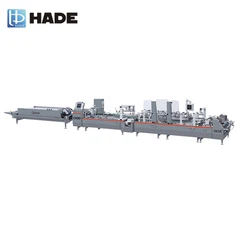

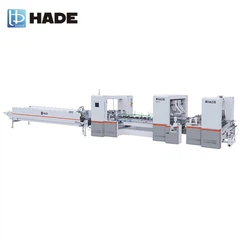
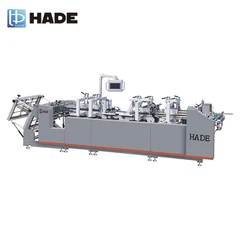
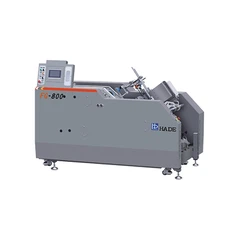
Under the background of rapid development of packaging industry, corrugated carton self-adhesive machine as core equipment to improve production efficiency, its stable operation directly related to a company's production capacity and product quality. However, in actual operation, equipment failures, process defects, environmental disturbance and other problems occur from time to time, leading to a decrease in production efficiency and an increase in scrap rate. This paper will analyze the common problems in the operation of automatic adhesive machine from three dimensions ofequipment operation, process control and environment management,and put forward some targeted solutions.
I. Core Challenges in Equipment Operation
1.Adhesion Quality Defects: From 'Poor Adhesion' to 'Surface Damage'
Insufficient bonding or partial degumming is one of the most common quality problems in production because of the mismatch between process parameters and material properties. For example, when the temperature is below the melting point of the adhesive (for example, below 160°C in some hot-melt adhesives) or the pressure is insufficient (below 3 kg/cm2), the adhesive layer cannot penetrate the fiber layer, causing the lining and surface material to separate. In addition, adhesive aging or residual silicone oil and other additives on the surface of the material may further weaken bonding strength.
The problem of excessive adhesive and adhesive penetration is directly related to uncontrolled process parameters. If the adhesive layer is more than 0.2 mm thick or has a high pressure (more than 5 kg/cm2), the adhesive can penetrate the back of the surface and form lumps and stains. A food packaging company because corrugated boxes surface adhesive layer is too thick, leading to the total scrap of products, direct economic loss of more than20,000 yuan.
Surface material is often damaged due to the failure of temperature control failures. Synthetic materials such as nylon and polyester fibers can melt and deform at high temperatures. If the temperature of the heating plate is more than 180 degrees Celsius, the surface of the corrugated box may appear yellowing or shrinkage. A logistics company has been forced to remake 5,000 delivery bins after they be scorched due to faulty temperature settings.
2.Transmission System failure: From 'belt dislocation' to 'surface scratching'
Belt misalignment is a typical fault in transmission system, the causes of which include non-parallel roller, uneven tensioner pressure, and improper equipment leveling of equipment. The corrugated box factory had straps that were out of place as a result of the settlement of equipment foundations and required the replacement of three belts per month at a cost of $5,000 each. Worse, misalignment can lead to surface scratches-a 0.6mm thick Teflon strap can be torn in hourswhen a hard object such as a button or zipper head is caught, production interruptions.
3. Temperature control system glitch: From 'slow heat' to 'Large waves'
Heating tube aging is the main cause of temperature control failures. One company used a 3-year adhesive machine that increase the resistance value of the heating tubes by 30%, lengthened the heating time from 15 minutes to 25 minutes, and reduced daily production capacity by 20%. In addition, incorrect PID parameters in temperature controller or poor thermocouple contact can lead to temperature fluctuations (e.g., between 160 and 200°C when set at 180°C), leading to the carbonization or inadequate bonding of binders.
ii. Key process control challenges
1. Material Compatibility: From "Adhesive Selection" to "Size Matching"
The compatibility of the adhesive and the material directly affects bonding quality. For example, boxes with a coated or varnished surface require special adhesives (such as water-based polyurethane adhesives) or pre-treatment, such as abrasion edges, to destroy the surface coating and improve permeability. A cosmetics packaging company had pretreated the coating box but failed to meet the requirements, resulting in a lack of bonding strength and a return rate of 15%.
Cardboard size accuracy is also key. If the cardboard has a parallelogram or trapezoid defect, bonding can lead to a "flared mouth" or "scissors difference." By introducing laser finishing equipment, one company reduced the angular error of the cardboard to ± 0.1° and the adhesion defect rate from 8% to 0.5%.
2. Parameter Optimization: Transition from Experiential Debug to Data-Driven
Traditional debugging relies on the operator's experience, which can easily lead to parameter deviations. For example, if a company sets the speed too fast (more than 12 m/min), the adhesive doesn't cool enough before moving on to the next step, which can lead to box being de-glued. Debugging time can be reduced from 2 hours to 20 mins by establishing a database of parameters (e.g. pure cotton + medium temperature lining: 150°C on upper plate, 140°C on lower plate, pressure of 3 kg/cm2, speed of 5 m/min) the debugging time.
III. Potential Challenges in Environmental Management
1. Dust pollution: From 'equipment wear' to 'electrical control failure'
Dust such as paper scraps and adhesive particles can seep into moving parts such as bearings and chains, accelerating wear and tear. A company without dust removal device had to replace the transmission chain every three months, adding $120,000 to annual maintenance costs. In addition, dust can clog up photoelectric sensors, leading to malfunctions (e.g., misalignment sensor failure of the sensor leads to belt misalignment).
2. Temperature and Humidity Control Failures: from 'material deformation' to 'electrical failure'
High temperature and humidity will accelerate the aging of the adhesive and reduce bonding strength. Experiments show that at 35°C and 80% RH, the opening time of hot melt is reduced by 40% and the operating window is reduced. At the same time, excessive humidity can lead to electrical faults (such as short circuits in control panels due to humidity). At one company, excessive humidity caused three adhesive machine control panels to burn, causing direct losses of more than half a million dollars.
IV. INTRODUCTION Systematic Solutions: From "Passive Maintenance" to "Proactive Prevention"
1. Equipment Selection: Focus on Core Configurations
Temperature control system: Doublezone independent temperature control and PID control control model, temperature control accuracy is within + -2 ℃.
Transmission System: Priority is given to Prioritize pneumatic pressing (pressure uniformity error ≤5%) and seamless环形 wiring (circular) PTFE belts (a joint flatness ≤0.1 mm) with automatic alignment devices (alignment sensitivity ≤5 seconds).
Consumable Parts Management: Vendors are requested to provide cost lists of key components, such as Teflon belts and heating tubes, with priority given to components with a replacement cycles of more than one year.
2. Process Standardisation: Establishing a "First-Piece Testing-Parameter Locking" Process
First test: 20cm x 20cm test kit is manufactured when materials are changed or parameters are adjusted, and peel strength tests (N /15 mm) and appearance inspections (no excessive adhesion or burns) are performed prior to mass production.
Parameter Locking: Enter validated parameters into the device control system and prohibit operators from modifying them at will. As a result, the company reduced the parameter debugging error rate from 12% to 0.3%.
3. Environmental Control: Implementation of Double Monitoring of ``Temperature,Humidity + Dust"
Temperature and Humidity Management: Installation of industrial-grade dehumidifiers and air conditioners in workshops to maintain temperature and humidity within 22 + 2°C and 55–60% relative humidity.
Dust proof: Install magnetic racks (to absorb broken needles and staples) and metal detection devices at the entrance of the adhesive machine, and clean the photoelectric sensor lenses and transmission components weekly.
4. Maintenance System: Establishment of a "Daily Cleaning-Regular Calibration
Daily cleaning: after daily downtime, use a copper scraper to remove adhesive residue on belt surface, clean feed tray and photoelectric sensors.
Regular Calibration: Monthly surface thermocouples used to measure the actual temperature of the heating panel. If the deviation exceeds 5 ° C, the PID parameters are recalibrated. If the deviation exceeds 5 5% the pressure difference between the left andright air pressure is measured using pressure test paper and air cylinders are adjusted quarterly.
Conclusion:
The stable operation of the corrugated box adhesive machine is the result of the协同 (synergistic) effect of equipment performance, process control and environmental management. By focusing on core configuration selection, establishing standard operating procedures, implementing dual environmental monitoring and upgrading maintenance measures, the overall benefits of equipment in enterprises will be raised from 65% to over 85%, and the goal of ``reducing costs and increasing efficiency "will be achieved. In the process of intelligent transformation of packaging industry, enterprises can remain competitive in the fierce market competition only if they meet the operational challenges with systematic thinking.
What Are The Common Challenges in Operating Automatic Gluing Machines For Corrugated Boxes?
Jun 30, 2026
Leave a message