

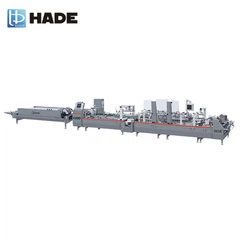

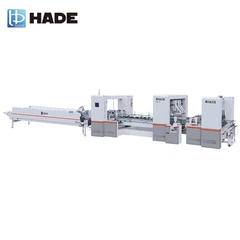
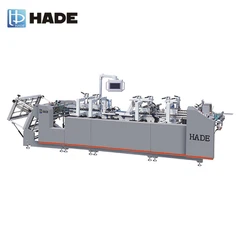
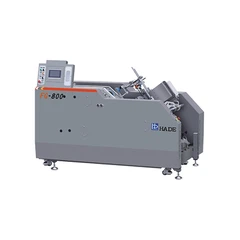
Amidst the thriving development of the packaging and printing industry, fully automatic folder gluers have emerged as pivotal equipment for enhancing production efficiency and packaging quality, thanks to their high efficiency, precision, and automation. They are extensively used in the production of various paper boxes, such as food packaging boxes, pharmaceutical packaging boxes, and cosmetic packaging boxes, meeting the market's urgent demand for diversified, high-quality packaging.
The performance quality of fully automatic folder gluers directly impacts packaging production efficiency and output quality, with their key components serving as the core factors determining equipment performance. Therefore, gaining an in-depth understanding of the main components of these machines holds significant importance for mastering operational principles, optimizing production workflows, and resolving practical issues.
Paper Feeding and Conveying Components of the Fully Automatic Folder Gluer
The paper feeding and conveying components constitute the initial stage of the fully automatic folder gluer. Responsible for accurately and steadily transporting cardboard sheets to subsequent processing stations, their performance directly impacts the continuity and stability of the entire production process.
Feeding Table:
The feeding table is the platform holding the stack of cardboard awaiting processing. Its design must account for the cardboard's dimensions, weight, and stacking method. Typically featuring an adjustable height mechanism, it accommodates cardboard of varying thicknesses. The table surface must be smooth and level to minimize friction between the cardboard and the table, ensuring sheets feed out smoothly.
Paper Separation Mechanism:
The separation mechanism's function is to isolate individual sheets from the stack, preventing multiple sheets (doubles or triples) from entering the conveyor belt simultaneously. Common separation methods include vacuum suction separation and friction separation. Vacuum suction uses nozzles to generate negative pressure, lifting and separating the top sheet. Friction separation utilizes the friction between rotating wheels and the cardboard sheet to achieve separation. The precision and reliability of the separation mechanism are critical for ensuring the quality of subsequent processing.
Conveyor Belt:
The conveyor belt is the key component transporting separated cardboard sheets to the forming and folding section. Constructed from rubber or polymer materials, it possesses necessary elasticity and wear resistance. Precise control over the belt's speed and tension is essential to maintain sheet stability during transport, preventing misalignment or vibration. Furthermore, the belt surface must be kept clean to avoid contaminants affecting sheet transport and processing.
Process Flow: During the feeding and conveying sequence, the feeding table presents cardboard to the separation mechanism. The separation mechanism isolates individual sheets and transfers them onto the conveyor belt. The conveyor belt then precisely delivers each sheet to the forming and folding section. The seamless coordination of these components prepares the material for the ensuing processing stages.
Forming and Folding Section of the Fully Automatic Folder Gluer
The forming and folding section is the core component of the fully automatic folder gluer. It transforms flat cardboard sheets into three-dimensional boxes with specific shapes through a series of precise folding and creasing operations.
Folding Guides:
Folding guides direct the cardboard along predetermined paths to achieve the required folds. Typically constructed from robust metal alloys, these guides offer essential strength and rigidity. Their shape and dimensions are customized according to the box design specifications. A highly polished surface minimizes friction during folding, ensuring dimensional accuracy.
Folding Plates:
Folding plates are the active components that execute the folding action on the cardboard. Employing either reciprocating (up/down) or swinging (left/right) motion, they fold the cardboard precisely along the pre-creased lines. Precise adjustment of the folding plate pressure and folding angle is critical for achieving consistent, high-quality box formation. The plates themselves are manufactured from materials exhibiting excellent wear and corrosion resistance to maximize service life.
Creasing Mechanism:
The creasing mechanism produces clean, well-defined fold lines in the cardboard, providing accurate registration points for subsequent folding. It typically consists of a creasing wheel and a creasing die (anvil). As the cardboard moves through, the rotating creasing wheel applies pressure against the die, impressing the fold line into the material. Crease depth and width require adjustment based on the cardboard's specific material composition and thickness to guarantee effortless and precise folding.
Process Sequence: During forming and folding, cardboard sheets enter the section via the conveyor belt. First, the creasing mechanism impresses the necessary fold lines onto the sheet. The folding guides then steer the cardboard along its designated path. Finally, the folding plates actuate to fold the cardboard along the creases. These components operate in concert to progressively convert the flat sheet into the desired box configuration.
Glue Application System of the Fully Automatic Folder Gluer
The glue application system is the critical component enabling box bonding in fully automatic folder gluers. Its performance directly determines the adhesive strength and final quality of the assembled boxes.
Glue Reservoir (Glue Pot):
The glue reservoir stores the adhesive supply. Its design must account for the adhesive's properties and application requirements. Typically constructed from stainless steel, it offers excellent corrosion resistance and thermal efficiency. The reservoir is commonly equipped with a heating element to maintain optimal adhesive temperature and an agitator to prevent settling or skinning, ensuring consistent adhesive viscosity and homogeneity.
Glue Application Roller:
The application roller uniformly transfers adhesive onto the designated bonding areas of the cardboard. Fabricated from rubber or metal with a specially treated surface, it provides consistent glue transfer and high wear resistance. Precise control of the roller's rotational speed and contact pressure is essential to achieve the required adhesive coating weight and thickness. Regular cleaning and maintenance are necessary to prevent adhesive buildup that could compromise application quality.
Glue Doctor Blade (Scraper Blade):
The doctor blade removes excess adhesive from the application roller's surface, ensuring a uniform adhesive film thickness. Made from metal or durable polymer, it maintains a precise, adjustable gap against the application roller. Modifying this gap regulates the amount of adhesive transferred. The blade design must prevent damage to the roller surface while maintaining effective glue metering.
Application Process: During operation, adhesive is fed from the reservoir to the application roller. As the roller rotates, it coats the cardboard's bonding areas with adhesive. Simultaneously, the doctor blade continuously removes surplus glue. This coordinated action guarantees uniform, precisely metered adhesive application, providing reliable bonding integrity for the box assembly.
Electrical Control Components of Automatic Carton Forming Machines
The electrical control components serve as the nerve center of the automatic carton forming machine. Through precise control and monitoring, they enable the automated operation of the equipment and coordinate its various movements.
PLC Control System
The PLC (Programmable Logic Controller) control system forms the core of the electrical control components. Using pre-written programs, it precisely controls all machine actions such as feeding, forming and folding, glue application, and drying. The PLC control system offers high reliability, strong resistance to interference, and flexible programming. It allows for program adjustments and optimization based on different production requirements, enabling multi-functional and intelligent operation.
Touch Screen Operator Interface
The touch screen operator interface provides users with an intuitive and convenient operating platform. Operators can use the touch screen to set various machine parameters like production speed, folding methods, and glue application volume. It also allows real-time monitoring of machine status, including fault alarms and production counts. The touch screen interface features simple operation and clear information display, significantly enhancing operational efficiency and maintainability.
Sensors
Sensors act as the primary feedback mechanisms for the electrical control components. They continuously detect the machine's operating status and environmental conditions, feeding this information back to the PLC control system. Common sensors include Photoelectric Sensors, Proximity Sensors, and Pressure Sensors. Photoelectric Sensors detect cardboard position and quantity; Proximity Sensors detect the movement position of mechanical components; Pressure Sensors monitor glue application pressure and folding pressure. The high precision and reliability of these sensors are crucial for ensuring normal machine operation and production quality.
During operation, the PLC control system directs the precise actions of all executing components based on both the preset program and the sensor feedback. The touch screen operator interface provides the user's interaction window, facilitating parameter setup and status monitoring. The coordinated interaction of all electrical control components ensures the efficient and stable operation of the automatic carton forming machine.
VI. Conclusion
The core components of a fully automatic cartoning system-namely the sheet feeding and conveying unit, forming and folding section, adhesive delivery system, and electronic control module-each fulfill indispensable functions during machine operation. The feeding unit delivers cardboard stock with precision and consistency; the forming section executes accurate folding and creasing; the adhesive system provides reliable bonding integrity; while the electronic controls enable automated processing with exacting command.
Synergistic interaction among these components governs the equipment's overall throughput and final packaging quality. Consistent high-volume production of premium cartons requires all subsystems to maintain peak operating conditions. Consequently, proactive maintenance protocols are essential in production environments. Implement regular component inspections, preventive servicing, and swift issue resolution to sustain operational reliability and manufacturing efficiency.
Moreover, as technological capabilities progress, continuous innovation reshapes automated cartoning systems. Industry stakeholders must monitor emerging technical developments and market evolutions. Ongoing refinement of machine performance and functionality remains critical to address escalating demands within modern packaging and print sectors.