

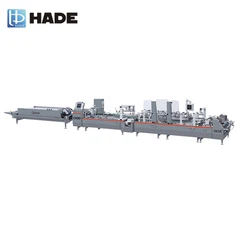

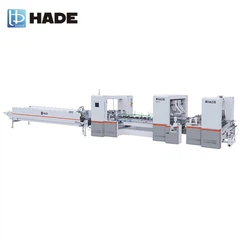
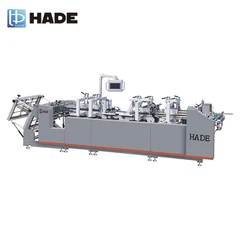
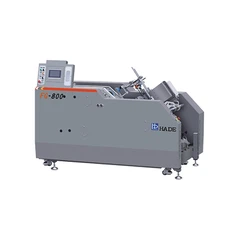
In the packaging printing industry, folding adhesive machine as a key equipment for carton forming, its operating stability directly affects the quality of products. However, common production problems, such as "openings" (deformation and dislocation of carton openings) and tilt of cartons, often lead to an increase product rejection rates. In this paper, the root cause is analyzed systematically from three dimensions:mechanical structure, process parameters and material properties,and a targeted solution is put forward.
1.Causes and adjustment of "foaming at Mouth" phenomenon
1.1 Addressing systemic weaknesses
Crease lines as the folding benchmark of the carton, the quality of the crease line directly affects the shaping accuracy of the carton. "Flared mouth" issues is usually caused by the following creasing system problems:
1.1.1 Excessive Crease Width.
When the crease steel wire is more than 1.5 times the width of the cardboard, excessive compression deforms the crease line, preventing it from folding precisely along the intended path. One enterprise, for example, uses 0.8mm of bent wire rope to produce 350g/m2 of bent corrugated steel with a width of 1.2mm and a 30 per cent fold.
1.1.2 Insufficient Pressure
Creasing pressures is less than 200N/cm2, the crease depths is only 40% of the thickness of the cardboard, and a slip occurs during the crease. Experimental data showed a 12% increase in "foaming at the mouth" for 50N/cm2 pressure reduction in blood pressure.
Adjustment Solutions:
Choose creasing steel wire matching paperboard thickness (Recommended width = paperboard thickness x 1.2)
Adjust crease pressure to 250-300N/cm2 using a pressure tester
dual-creasing process: 150N/ cm2 in pre-fold and 280N/cm2 in final creasing
1.2 Folding Mechanism Misalignment
The hinge represents the core module that controls carton forming, and parameter misalignment leads directly to the "opening":
1.2.1 Folding Bar Installation Deviation.
When bar perpendicularity error of the hinge exceeds ±2° relative to crease lines, the hinge produces lateral force during folding. One enterprise observed a 5mm opening deviations after installing a 3 inclination folding rod.
1.2.2 Abnormal Belt Spacing
belt spacing shall be greater than 0.5-1mm of paperboard width. Too much spacing can lead to misalignment during folding, and not enough spacing can damage cardboard surfaces.
Adjustment Solutions:
Calibrating the verticality of the folding rod with a laser leveler
Adjust folding belt spacing to (paperboard width + 0.8)mm through tensioning wheels
Install guide plates in folding areas to stabilize the movement of cardboard.
1.3 Material Deformation Effects
Paperboard moisture content and stiffness of cardboard have a great influence on the molding quality:
1.3.1 Excessive Moisture Content
When paperboard moisture exceeds 12%, the evaporation of water in folding process causes local shrinkage deformation. Experiments show that for every 2% increase in moisture, the deformation rates increases by 18%.
1.3.2 Insufficient Stiffness of Hardness
Low-grammage paperboard (<250g/m2) is not flexure-resistant, resulting in deformation when folded.
Solutions:
Maintain workshop humidity between 45% and 65%.
Preheat high-moisture paperboard (60°C for 30 minutes)
Opt for higher-stiffness paperboard or extra ply count
2. Reasons and adjustment of Carton Skew Issues
2.1 Conveyor System Failures
Dislocation of cardboard during conveyance represents the main cause of tilt:
2.1.1 Belt Slippage Sliding
When the friction coefficient of the conveyor belt is less than 0.4, the cardboard will slip during acceleration. One business has a 15% bias due to the accumulation of paper dust, which reduces friction to 0.3.
2.1.2 Vibrator Parameter Misalignment
Relative to the size of the cardboard Improper vibration frequency, will lead to uneven stacking density. For 800×600mm paperboard, the optimum vibration frequency is between 80 and100Hz.
Adjustment Solutions:
Improving the surface roughness of strip by sandblasting
Install paper dust removal systems (e.g., negative pressure suction)
Adjust vibration frequency to (paperboard length × 0.1)Hz by frequency converters
2.2 Die-Cutting Precision Defects
Die cutting errors are transferred directly to the bonding process:
2.2.1 Dimensional Deviations
Die cutting plate tolerances greater than ±0.2mm will cause the deviation of paperboard glue flaps. One reported a 25 per cent offset of a 0.3mm size error.
2.2.2 Dislocation of crease lines.
Spacing errors between crease and die-cut line is greater than 0.5 mm, which changes folding reference.
Solutions:
Production of die cutting plates using ± 0.1mm tolerances laser cutter
Die-Cut-gluing联动 (Connection) Connection Calibration Using Adhesive Machine crease lines as Reference
Added full-size projection inspection for die-cutting plates
2.3 Improper Adhesive Application
Adhesive properties and application methods have important influence on molding:
2.3.1 Excessive Glue Application
Coating >0.5mm will cause local swelling due to adhesive penetration. Tests show that for every 0.1mm increase in coating, the slope increased by 9%.
2.3.2 Insufficient Drying Time.
Slow-curing adhesives are prone to displacement under pressure before they complete solidification.
Adjustment Solutions:
Control coating thickness between 0.3 and0.4mm using a doctor blade system
laminated paperboard using quick-curing adhesive (initial curing time <8 seconds)
Add infrared dryer to reduce curing time to <3 seconds.
3. Comprehensive solutions and preventive measures
3.1 Equipment maintenance systems
3.1.1 Three-Level Maintenance Regimen
Daily maintenance: cleaning conveyor belts, check creasing pressures
Weekly maintenance: calibration of bar perpendicularity, lubrication of drive elements
Monthly maintenance: Inspect die-cutting plate precision, replace wear belt.
3.1.2 Critical Component Lifecycle Management
Creasing steel wire use: replace after 500,000 production cycles
Folding bands: Replace every 2,000 hours
Conveyor bearings: replaced every 5,000 hours
3.2 Process Optimization Solutions
3.2.1 Parameter Standardization of parameters
Preparation of a "Folding Gluer Process Parameter Tables" showing creasing pressures and folding speed of different paperboards
Implement digital control systems for automatic recovery and storage of parameters
3.2.2 Material Preprocessing
Preheat high-moisture paperboard (70°C for 20 minutes)
Apply a coating to the surface of low-stiffness paperboard ((increasing stiffness by 15-20%)
3.3 System of personnel training
3.3.1 Operational Skill Training
Theoretical training on the structure and parameter adjustment of adhesive machine;
Implementation of simulated fault elimination exercises (e.g. intentional creation of "flared mouth" defects)
3.3.2 Quality Awareness Enhancement
Establish an initial inspection system of 3 samples per batch.
Implementation of a quality tracking system to record equipment parameters and operators for each batch
4. Case studies
A packaging enterprise that makes 330×220×180mm food cartons encounters had a severe "flared mouth" issues. Inspection found:
1.5mm crease steel wire (1.2mm paperboard thickness)
Folding belt spaced more than 3mm across cardboard
75% humidity in workshop
As a result of these measures, product compliance rate increased from 72 per cent to 98 per cent:
Replace 1.4mm creasing steel wire with pressure adjusted to 280N/cm2
Set belt spacing to 331mm
Install a dehumidifier to maintain 60% relative humidity
Training of operators on adjustment procedures for folding rods
V. Conclusion:
The problem of horn and carton deflection in folding adhesive machine is the result of the interaction of mechanical precision, process parameters and material properties. Establishing systematic equipment maintenance, implementing precise process control, and strengthening personnel quality awareness can effectively reduce these defects. With the development of intelligent detection technologies, future solutions may combine vision inspection systems for real-time quality monitoring to achieve a shift from passive maintenance to active prevention and support high-quality development of the packaging industry.
What Are The Potential Causes And Adjustment Methods When A Folding-gluing Machine Produces Cartons With A Flared Opening Or Skewing During Production?
Jul 30, 2026
Leave a message