

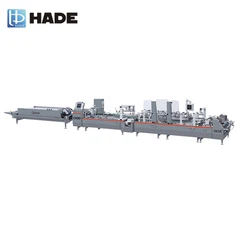

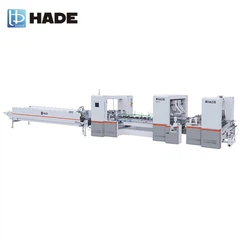
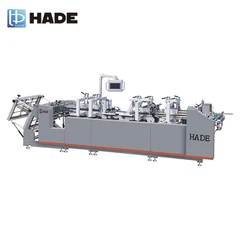
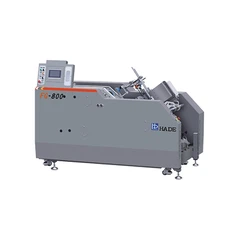
In the packaging printing industry, automatic carton folding machine as core equipment of post-printing processing is reshaping the standard of production efficiency at an alarming rate. From the traditional manual origami machine production of 30,000 units a day, to the modern automatic origami machine production of 50,000 to 60,000 units a day, this leap reflects not only technological progress, but also the industry's dual pursuit of efficiency and quality.
Speed break: from 'tiny' to 'level two'.
Current mainstream fully automated cardboard folding and adhesive machines range from 400m/ min to 650m/ min, with some high-end models exceeding 800m/ min. Take the JY1100SG model, which has a maximum speed of up to 400m/ h and, combined with 18 fully intelligent centre console tuning systems, delivers a box change in under 15 minutes,a 70% reduction in setup time compared to conventional devices. Zhejiang Xinluolan's XL series stores the positioning parameters of carton of different specifications in the cloud, and realizes "one-click mode switch" which further improves the efficiency, and the comprehensive utilization rate of the equipment over 92%.
This speed advantage is particularly pronounced in mass production. For example, a pharmaceutical packaging company that uses the NH-1180B corrugated carton folding machines and adhesive machines has seen its single-line daily production capacity soar from 120,000 to 360,000 units. E-flute corrugated box fold rate increased from 78% to 95% by combining dual creasing and reverse compression technology. Remarkably, the electronic sensor of the device automatically matches the folding speed and ensures that stacking accuracy of the carton is within ±0.5mm, completely solving stacking problem in high-speed operation.
Efficiency Code: Synergistic Evolution of Modular Design and Intelligent Control
The efficiency revolution in origami and adhesive machines is the result of breakthroughs in three core technologies:
Servo Drive System: Independent servo motors drives eight key modules, such as paper feeding, prefold, bottom locking, etc., to achieve precision control of 0.01mm. The XCS-650PC model, for example, improves power transmission efficiency by 40% through high-power stepless variable frequency technology while reducing noise to less than 65 decibels.
Modular Architecture: Mainstream equipment adopts a "base platform + functional module" design, allowing users to add features such as spray system or special-shaped box forming devices flexibly according to production needs. A cosmetics packaging company expanded the scope of application of equipment from 3 to 12 packaging boxes, adding a hexagonal box forming module based on standard type, increasing the comprehensive utilization rate of equipment by 300%.
Intelligent control system: PLC computer control and human-machine interface, with synchronized speed adjustment, precision glue quantity control and other advanced functions. The Xinluolan XL series comes with 16 servo drivers that independently regulates拐带 the speed of theconveyor belt, improving the production efficiency of the xenobox by 80% compared to conventional machinery.
The art of balancing efficiency and quality
In pursuit of speed, fully automated cardboard folding machines and adhesive machines maintain quality stability through a variety of innovations:
Pressure control technology: Pneumatic rear units is equipped with wireless remote electric pressure adjustment device, which can achieve precise pressure adjustment between 0.1 and 0.1-5N/cm2 depending on the thickness of the carton. A liquor packaging company applied the technology to reduce the standard deviation of the crate's crease depth from 0.3 millimeters to 0.05 millimeters.
Glue Quantity Control System: specially designed buckets, combined with electronic spray system, limit the fluctuation of glue consumption in a single box to ±0.02g. Tests shows the technology reduces the amount of glue used by 15% while increasing bonding strength to 1.2 times the industry standard.
Real-time Monitoring System: The integration of Panasonic photoelectric sensors and counters allows dual counting modes (total/quantity) to be carried out in parallel with the automatic paper ejection mechanisms, keeping waste rate below 0.3%. One e-packaging company used the system to reduce customer complaint rates from 2.1% 0.5%.
Industrial transformation driven by efficiency revolution
Improved efficiency of origami and adhesive machines is leading to profound transformations in the supply chain transformations:
Evolution of the production model: A printing enterprise deployed four XL-1100 models to create a "24-hour unmanned workshop," reducing manpower requirements each line from 12 to 3 while reducing delivery cycles from 72 to 18 hours.
Accelerator iteration: domestic manufacturers are integrating core components such as German synchronous belt drives and Japanese Nitta flat folding belts, extending the failure interval from 2000 hours to 5000 hours,reaching international advanced level.
Service model innovation: leading companies now offer ``equipment + process' 'integrated solutions. Xinluolan's Smart Carton Folding Cloud Platform, for example, monitors real-time operating data on more than 2,000 devices worldwide, using artificial intelligence algorithms to predict maintenance needs and boost overall device efficiency to above 85%.
From the perspective of industry development, the efficiency revolution of carton folding machine and adhesive machine is not just speed. Through intelligent, modular, and precision system innovation, these machines have constructed a Golden Triangle of Efficiency, Quality, and Cost. With the integration of 5G and industrial internet technologies, future of carton folding devices will be "light" and propel the packaging industry in the direction of higher efficiency and quality. Led by self-folding and gluing carton machines, the efficiency revolution is redefining the boundaries of possibility in modern packaging production.