

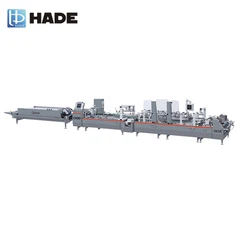

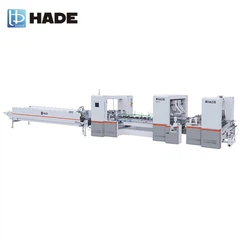
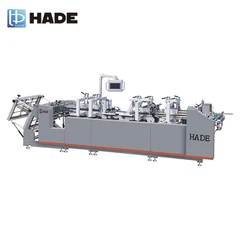
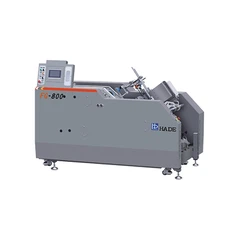
In the packaging printing industry, fully automatic folder gluers has become a key equipment for carton forming with its high efficiency and precision automatic production capabilities. However, in actual production, the problem of carton deformation occurs frequently, which not only affects the appearance and quality of the product, but also may lead to mass production rework and increase production cost. In this paper, the causes of carton deformation will be analyzed systematically from three dimensions: material, process and equipment,and a targeted solution will be proposed.
Material factors: control deformation risk from the source.
1.Imbalanced Moisture Content
Paper moisture content is the core factor that influences the stability of carton. When environmental humidity and the paper's moisture content do not match, paper is prone to ``curl '', ``tight edge "and other phenomena. For example, during the rainy season, if the paper is not pretreated, the die-cut carton may expand during bonding due to moisture absorption, forming openings or bulging sides.
Solutions:
- Environmental control: Installation of a dehumidifier or humidifier in the workshop to maintain a suitable humidity range of 50 to 65 per cent, with real-time monitoring by a temperature and humidity recorders.
- Paper pretreatment: Preheat and dry paper in a high humidity environment, or spray and moisten low humidify low-humidity paper to even out its moisture content. One packaging enterprise used smart humidity humidity control system reduce the carton deformation rate from 8 percent to 1.2 percent.
2.Discordant direction of paper fibers
When the fiber direction of the paper is parallel to the opening direction of the carton, the opening of the carton tends to bulge after forming due to fiber elasticity. For example, cosmetic gift boxes using a longitudinal fiber direction had an open convex angle of 15° when glued together, severely affecting product presentation.
Solutions:
Layout optimization: In preprint design, ensure that the opening direction of the carton is perpendicular to the paper's fiber direction. CAD software is used to simulate the stress distribution and adjust the layout angle.
Material substitution: Use a transverse fiber direction or high-density cardboard to improve the paper's resistance to deformation. A food packaging company has completely solved the problem of open-mouthed bulging by switching to 250 g/m2 high-density white cardboard.
Process Factors: Adjust Adhesive Parameters Precisely
1.Die cutting plate Insufficient Precision;
Manual die-cutting plate often due to crease line depth and folding angle deviation, resulting in inconsistent carton dimensions. For example, the medicine cabinet die-cut has a 0.3mm depth deviation in the crease line, resulting in a side height difference of more than 2mm and significant steps when glued together.
Solutions:
- Laser Die Cutting Upgrade: Die Cutting Board is produced using laser die-cutting technology to ensure crease line depth error ≤ 0.05 mm. The pass rate of die-cutting increased from 92% to 99.5% after the introduction of laser die-cutting in an electronic packaging enterprise.
- Crease parameter optimization: Adjust the fold steel wire pressure according to the thickness of the paper. For example, the fold pressure of 200 g/m2 cardboard is 120N/ cm, and the width of the fold groove is controlled to 1.5 times the thickness of the paper.
2.Improper Selection of adhesives
Adhesives that insufficient viscosity or do not match the material will cause the carton to absorb moisture and deform. For example, laminated cardboard boxes using ordinary paper-to-paper binders failed to penetrate the film layer, resulting in a 30 per cent degumming rate after 24 hours of bonding, while the high water content of the binder caused the cardboard to absorb moisture and warp.
Solutions:
- Classification and selection of adhesives:
For untreated cartons: choose a pulp binder with a high solid content and fast drying (viscosity: 8000-12000 mPa / s).
For laminated/varnished cartons: special adhesives (e.g., hot-melt adhesives) from film to paper or, during die-cutting, piercing the film layer with a needle knife (hole diameter: 0.2 mm, spacing: 5 mm).
For low temperatures: use hardy adhesive (brittle temperature ≤ -15°C).
- Glue application control: The output of the glue gun is precisely controlled by PLC system, such as the straight-line box glue application rate is maintained at 0.08-0.12 g/cm2 to prevent excessive glue penetration and cardboard deformation.
Equipment Factors: Smart adjustable the Folder Gluer Status
1.Folding machine Imbalanced Pressure System
Insufficient or uneven pressure on the folder gluer can lead to poor adhesion and deformation. For example, the automatic folder binder had a 15% pressure deviation on the roller, resulting in a 3 mm difference in the side height of the carton after the binder is glued.
Solutions:
- Pressure calibration: pressure sensors used to monitor pressure in real time and automatically adjust pressure values through servo motors to ensure a pressure error ≤ 5% per pressure point.
- Prolonged pressing time: For self-locking chassis, increase compression time from 2 seconds to 4 seconds to improve adhesion strength. With this adjustment, the the debonding rate of liquor packaging plant was reduced from 5% to 0.3%.
2.Poor Synchronization of delivery systems;
Improper adjustment of the folding machine or the dislocation of the hinge rod will lead to the carton on the left and right sides of the inconsistent conveying speeds, resulting in the adhesive joint skewed. For example, the folder binder had a height deviation of 2mm, resulting in a 5mm deviation of the bonding joint after bonding.
Solutions:
- Gearbox calibration: Real-time adjustment of the speed of the left and right conveyor conveyor belts Use encoder feedback systems to ensure a speed differential ≤ 0.5%.
- bar precision: Adjust the position of the crease using laser alignment tools to ensure a vertical error of ≤0.1 degrees between the crease and the crease lines. A cosmetics packaging company reduced the mismatch rate from 7% to 0.5% through the adjustment.
INTRODUCTION Case study: Comprehensive improvement plans for enterprises
A large packaging enterprise once faced with a carton deformation rate of up to 12%, through the following measures to achieve a significant improvement in quality:
- Material upgrade: change to 250 g/m2 high-density white cardboard with smart humidity control system.
- Process optimization: laser die-cutting plate was used to increase die-cutting accuracy to ±0.05 mm; film hot melt adhesive was used to control the amount of glue application to 0.1 g/cm2.
- Equipment modification: upgrade the folder gluer's pressure control system to reduce pressure error to ≤3%; install laser alignment tools to calibrate folding bars.
After implementation, the carton deformation rate decreased to 0.8%, saving more than $2 million a year in rework costs and reducing customer complaints by 90%.
Conclusion:
To solve the problem of carton deformation, a systematic study should be carried out from the aspects of materials, technology and equipment. By precisely controlling paper moisture content, optimizing layout design, selecting suitable binder, calibrating folder gluer parameters, etc., the quality of carton forming can be significantly improved. With the popularization of intelligent detection technologies, such as machine vision and pressure sensing, the future of gluing technology will achieve full process digital control, further pushing the packaging industry in the direction of higher quality and efficiency.