

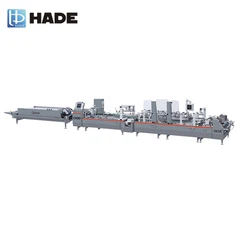

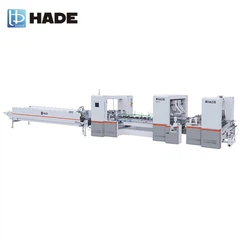
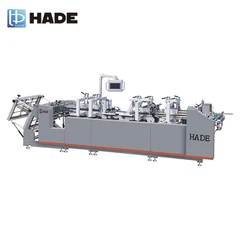
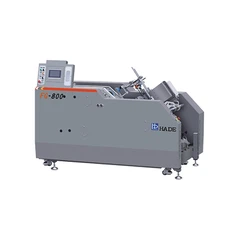
In the field of packaging machinery, as the folder gluer machine core equipment of carton forming, the efficiency of the design directly affects the ability of enterprises to respond to market changes. By decomposing complex systems into standardized functional units and combining parametric design with digital management, modular folder gluer machines have gained significant advantages such as shorter design cycles, lower maintenance costs and faster product iteration. This paper discusses the efficient design logic of modular folder gluer machines from three dimensions: design method, technology implementation paths and industry practice case.

Core Methodology to Modular Design Products Description
1.1 Functional Decomposition and Standardized Interfaces
The essence of modular design lies in the systems engineering method of ``divide and rule ''. Take the paper feed module of a folder gluer machine as an example and decompose its function into three submodules: paper positioning module, transport module and alignment module. Each submodule is quickly assembled through standardized interfaces such as mechanical locating pins and electrical connectors. A German packaging machinery company has built a standard library of modular interfaces that seamlessly replace paper feeding devices from different suppliers and reduce the debugging time from 72 hours to just 8 hours.
1.2 Construction of Parametric Master Models
Using UG NX and other CAD software to establish parametric master models is the key technology of modular design. A folder gluer machine manufacturer designed the folding knife rack module as an adjustable parameter model. By modifying parameters such as ``fold angle"and ``tool shelf spacing '', a knife holder assembly can be generated suitable for different carton types. This approach reduces the lead time for non-standard parts from three weeks to three days and reduced the design error rate by 67%.
1.3 Topological Optimization of Module Combinations
the topological relationships mathematical modeling and analysis modules can greatly improve design flexibility. A team of researchers used graph theory to construct a modular combinatorial network of folder gluer machines and found that when the number of modular types is controlled between 15 and 20, more than 200 machine configurations can be combined, meeting more than 85% of market demands. This strategy of ``limited-module unlimited portfolio"has tripled the return on investment of enterprise R&D resources.
Efficient Design of Technical Implementation Paths
2.1 Digital Design Resource Building.
Based on the IMAN process resource management system, an enterprise has built a digital library containing more than 3,000 standard modules. The library has three core functions:
- Intelligent search: the system automatically recommends the appropriate module combinations by entering parameters such as carton dimensions and material thickness.
- Version management: It records the history of more than 200 design parameters per module.
- Synergy Design: Supports concurrent design of multi-user call modules simultaneously.
- the Modular Manufacturing System
Modular design has a profound impact on manufacturing processes.
Among them, the production line of the clamping machine has realized the modular unit manufacturing mode, which transforms traditional serial production into parallel production:
- The folding module is finely processed in a CNC machining center and then goes directly into the assembly unit.
- The adhesive module is assembled in an integrated manner and is tested and qualified before entering the final assembly line.
- Final assembly time was shortened from 120 hours to 48 hours, and constructionin progress inventory was reduced by 75%.
2.3 Intelligent Maintenance System Integration.
Modular design provides the basis for predictive maintenance. A new folder gluer machine integrates sensors into each module to collect real-time data on vibration, temperature and other parameters. Machine learning algorithms predict the remaining lifespan of modules. When the bearing wear in the feed module exceeds the threshold, the system automatically generates maintenance work sheets and recommends replacement of the module model, increasing the Overall Equipment Effectiveness of the equipment to 92%.

Industry Practice Case Study
Case 1: Modular Iteration of the International Packaging Group
The enterprise advanced modular design in three phases:
Basic Module Development: Divide The folder gluer machine into four basic modules: paper feeding, folding, bonding and molding.
Functional Module Expansion: A differential strength folding module for microflute, E flute and F flute corrugated cardboard has been developed.
Intelligent Module Upgrades: The vision inspection system was integrated in the bonding module to realize automatic glue quantity compensation.
With the implementation of modular design, the development cycle of new products has been shortened from 18 months to 6 months, and the proportion of custom orders has been increased from 30 per cent to 65 per cent, resulting in annual savings of more than $20 million in design costs.
Case 2: Modulation of non-standard components in domestic enterprises
According to the production characteristics of small batch and multi-variety orders in domestic packaging enterprises, one enterprise innovatively implemented non-standard parts modularization:
A database of non-standard parts parameters has been set up, covering more than 200 special carton solutions.
Modular rapid configuration software was developed to enable designers to complete 80% of their design work through drag and drop operations.
Modular manufacturing unit transformations, non-standard parts processing efficiency increased by 40%.
The solution shortened the lead time for delivery of non-standard orders from 45 to 15 days and increased customer satisfaction by 28 percentage points.
Future Development Trends
modular folder gluer machines will evolve to a higher level of intelligence as technologies such as digital twins and artificial intelligence merge:
- Self-Configuration System: Through digital twin technology, equipment can automatically adjust module combination according to order.
- Adaptive Control: Artificial intelligence algorithms will optimize the operating parameters of each module in real time to achieve dynamic balance.
- Self-healing: When a module failure is detected, the system automatically deploys backup module and plans to maintain the path.
Smart modular folder binders are forecast to account for 70% of the high-end market by 2028, with device lifecycle costs dropping by over 40%, according to research.
Modular design is not merely a kind of technological innovation, but also a strategic choice for packaging machinery enterprises to build core competitiveness. By establishing scientific design methodology, comprehensive digital system and innovative application mode, enterprises can maintain continuous competitive advantage in rapidly changing market environments, and realize the leap from ``manufacturing"to ``intelligent manufacturing ''.