

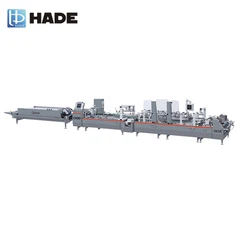

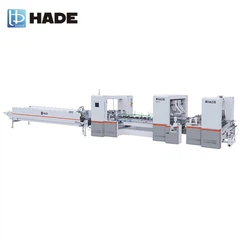
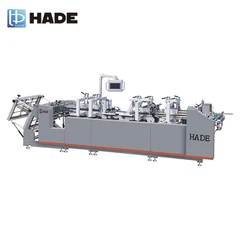
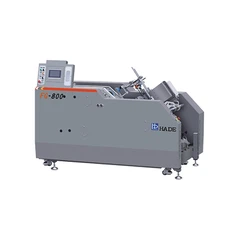
In the packaging printing industry, glue machines is the core equipment of post-printing processing. Their operational efficiency has a direct impact on order delivery cycles and production costs. In order to meet the demands of mass production, enterprises need to design system solutions from three key dimensions: equipment optimization, process innovation and digital management, and achieve dual breakthroughs in capacity and quality.
I. Deep Equipment Performance Optimization: Breaking the Hardware-Level Efficiency Bottlenecks
1.Precise Adjustment and Parameter Matching
The core parameters of the folding machine (conveyor belt speed, amount of glue application, pressure) must be dynamically adjusted according to the material and process requirements of the carton. For example, Tianjin Changrong Tianjin folder glue machine has been repeatedly tested to find that when the ratio of conveyor belt speed to carton size is controlled at 1:0.8, it maximizes conveying efficiency while preventing tilting and stacking. Roland's folder glue machine equipped with digital control system, automatic identification of carton types, matching the best parameters, the Overall Equipment Effectiveness increased by 23%.
2.Upgrade Key Components
- Glue Application System: For special surface treatments, such as laminate and UV varnish, high permeability binders and smart spray guns are required. One enterprise upgraded the traditional roller glue system to a servo-driven spray glue device, increasing the uniformity of the glue application to 98% and reducing glue waste by 30%.
- Compression mechanism: the use of segmental pressure adjustment technology, can be different fold area differential pressure adjustment. For example, in a crochet carton types, the corners require to be increased by 15%, while the flat adhesive areas need to be reduced to prevent deformation.
3.Establish preventive maintenance systems
IoT-based data collection systems continuously monitor more than 200 parameters, such as motor speed and robotic arm displacement, to create an overview of device health. One packaging enterprise implemented the system, achieving a 92% accuracy rate in fault prediction and reducing unexpected downtime from 12 hours to just 3 hours per month.
Process re-engineering: standardization for efficiency revolution
1.Systematizing Standard Operating Procedures
Develop comprehensive SOPs covering equipment startup, parameter setting and quality inspection. One enterprise developed a "Five-Step Debugging Method":
- Testing mechanical accuracy when running on empty.
- Parameters were validated by producing 50 cartons of samples.
- Fine tuning pressure and curing time.
- Monitor stability at full speed.
- Optimal combination of curing parameters.
The training period for new employees was shortened by 60% and the product qualification rate remained stable at over 99.2%.
2.Dynamic Production Scheduling and Order Change Optimization
Similar carton types are produced in groups using modular production unit design. One enterprise implemented the "three identical" (same material, structure and size), reducing order turnaround times from 45 minutes to 8 minutes and increasing daily capacity by 18%. For high frequency, small batch orders, a quick mold change system with a prestored parameter template can replace model in 10 minutes.
3.Closed-loop management of Quality Defects
Create a database of 12 common defects, such as glue failure and flared edges, and use Failure Mode and impact analysis (FMEA) to determine root causes. For example, to fix glue failure caused by low temperatures in winter, one enterprise installed a temperature and humidity control chamber on its production line, maintaining the environment between 20 and25 degrees Celsius and increasing the strength of the adhesive by 40%.
Digital Empowerment: building a new ecosystem of intelligent manufacturing.
1. Integration with industrial Internet Platforms.
Roland's folder glue machine are equipped with digital control system that integrate seamlessly with ERP and MES systems and enable:
- Real-time production dashboards showing equipment utilization and order progress.
- Smart early warning systems that automatically trigger replenishment orders when glue levels is less than 10%.
- Remote maintenance support for engineers through AR glasses.
- For one enterprise implementing the platform, production transparency improved by 75% and decision response time by 50%.
2.Big data-driven decision-making
The capacity prediction model was established by collecting more than 3,000 production data points. One enterprise, for example, found that when humidity exceeds 65%, carton deformation rates increase by 12%. With that in mind, they adjusted their production schedules to increase on-time delivery during the peak season to 98%.
3.AI-Powered Visual Inspection Upgrades
A visual inspection system that incorporates a deep learning algorithms can detect a 0.1mm adhesive bias. One enterprise deployed the system, reducing the frequency of manual sampling from one per hour to two per day and increasing inspection efficiency 20-fold.
INTRODUCTION Case study: the value of quantitative Efficiency Improvements
Large packaging enterprise have achieved remarkable results by implementing these solutions:
- Equipment Efficiency: OEE from 68% to 89%.
- Labour costs: the number of operators per line has been reduced from 4 to 2.
- Production Capacity: From 150,000 to 280,000 cases per day.
- Quality Metrics: Customer complaint rates fell to 0.3%.
Verdict: The Continuous Evolution of Efficiency Enhancement
In the age of intelligent manufacturing, improving the efficiency of fully automated binders has entered the 3D drive stage of "hardware + software + data." Enterprises need to establish collaborative optimization mechanism for equipment, processes and digitization, which are continuously improved through the PDCA (Plan-Do-Check-Act) cycle. In the future, with the further application of technologies such as 5G and digital twin, glue production will move towards the ultimate goal of zero faults, zero defects and zero waste, injecting lasting momentum into the large-scale development of the packaging industry.